THE RISEN YESHUA

Living In The Overlap
Seeing Beyond What’s Physical.
Paschal Benjamin
8/29/20256 min read
Living in the Merge of the Supernatural and Natural: Seeing Beyond What’s Physical
Introduction
In the midst of life's challenges, there is a place in God where the realms of the supernatural can merge or overlap with our natural realm. I like to call this the overlap or the merge.
We often face difficulties that lead to despair, and it’s easy to become limited by what we can see. But I want you to know that there’s a door through which we can draw from the supernatural and bring it into our natural realm.
Often, our troubles arise from our limited understanding and faith in what is beyond the physical. This restricts us from accessing the unseen resources that God has already placed around us. However, these resources are ready to spill into our natural world if we begin to expect and believe that they can manifest in our day-to-day lives.
Throughout Scripture, we find examples where God's supernatural power intersects with our physical world to provide for His people during times of need. From Hagar’s well and Abraham’s ram to the rock at Meribah, the widow of Zarephath, Elisha’s miracles, Jesus’ loaves, and Esther’s decree, we see God’s divine law of “let there be,” calling things into existence. We also see His law of divine multiplication, where the natural is overwhelmed by the supernatural.
In the story of Esther, we observe how a new decree can override death, mirroring the victory of Jesus. In this article, we’ll explore these accounts and learn how to step through the door of faith to experience this sacred merge, writing new decrees in God’s name to see beyond what’s physical.
1. Hagar’s Well and Abraham’s Ram: God’s Instantaneous Provision
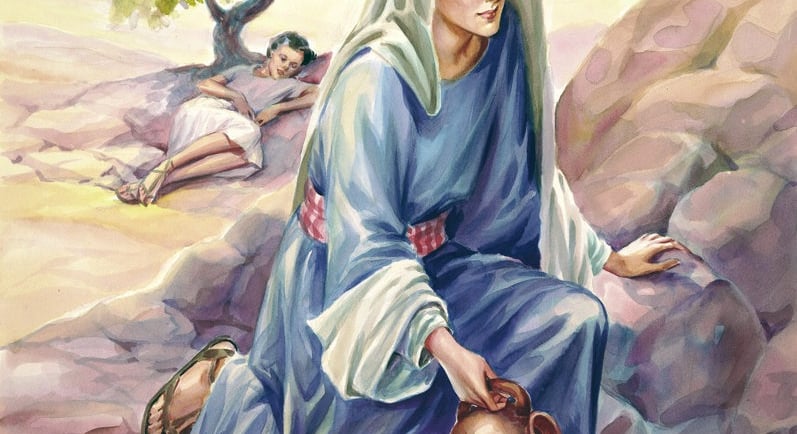
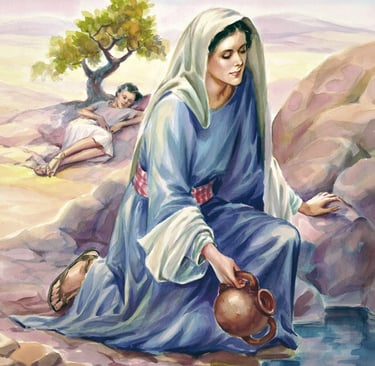
In Genesis 21:19, Hagar, having been cast into the wilderness with her son Ishmael, faces despair as their water supply runs out: “Then God opened her eyes and she saw a well of water.” The Hebrew word paqach, meaning “to open,” implies a divine revelation, merging the spiritual and natural realms. A well that was invisible to her before is suddenly revealed—a supernatural provision that intersected with the natural world.
Similarly, in Genesis 22:13-14, when Abraham is about to sacrifice his son Isaac, God stops him and provides a ram: “Abraham looked up and there in a thicket he saw a ram caught by its horns. He went over and took the ram and sacrificed it as a burnt offering instead of his son.” Before God commanded Abraham to look, no ram was visible. Yet, God’s supernatural provision appeared in the natural world at the moment of faith. This mirrors Genesis 1:3, when God called light into existence with the words: “Let there be light,” and it was so.
Both Hagar’s well and Abraham’s ram reveal God’s power to bring unseen resources into the natural realm through faith and divine revelation.
2. The Rock at Meribah and Beyond: Divine Multiplication
In Numbers 20:8-11, the Israelites, desperate for water in the wilderness, are instructed by God to speak to the rock, but Moses strikes it instead. “Water gushed out, and the community and their livestock drank” (Numbers 20:11). Though no permanent spring exists at that site today, the rock provided water in a supernatural act that broke through the natural limits.
The principle of divine multiplication appears in several stories. In 1 Kings 17:8-16, during a famine, Elijah encounters a widow who has only a handful of flour and a little oil. Elijah tells her, “For this is what the Lord, the God of Israel, says: ‘The jar of flour will not be used up and the jug of oil will not run dry until the day the Lord sends rain on the land.’” (1 Kings 17:14). The oil and flour continue to multiply, providing for her family throughout the famine.
In 2 Kings 4:1-7, God, through Elisha performs a similar miracle. A widow with a small jar of oil is instructed to borrow empty vessels from her neighbors. “She kept pouring… until all the jars were full” (2 Kings 4:6). This miraculous multiplication of oil is a vivid example of how God can take something small and multiply it beyond its natural capacity.
In Matthew 14:19-20, Jesus multiplies five loaves and two fish to feed five thousand men, with twelve baskets of leftovers: “They all ate and were satisfied, and the disciples picked up twelve basketfuls of broken pieces that were left over.” These stories showcase the law of divine multiplication—where God takes what is little and makes it much, far beyond natural limitations.
3. Elijah’s Ravens and the Angel’s Bread: Supernatural Provision
In 1 Kings 17:4-6, when Elijah is hiding from King Ahab, God commands ravens to feed him by bringing him bread and meat. “The ravens brought him bread and meat in the morning and bread and meat in the evening, and he drank from the brook.” This repeated, supernatural provision of food shows how God can use the most unexpected means—ravens, in this case—to meet our needs.
In 1 Kings 19:5-8, after Elijah flees from Jezebel, an angel comes to him, touching him and offering him bread baked on hot stones: “Get up and eat, for the journey is too much for you.” Elijah is sustained by supernatural provision from heaven, not just once, but twice, illustrating God’s care and how the supernatural sustains the natural.
4. Esther: A Mirror of Jesus and the New Decree
In the Book of Esther, Haman persuades King Ahasuerus to issue a decree to annihilate the Jews: “Letters were sent by couriers to all the king’s provinces with the order to destroy, kill and annihilate all the Jews… in one day” (Esther 3:13). But after Haman is defeated, a new decree is issued that saves the Jews: “Write another decree in the king’s name on behalf of the Jews… and seal it with the king’s signet ring—for no document written in the king’s name and sealed with his ring can be revoked” (Esther 8:8). This decree, though it didn’t undo the first one, overrode its effect and brought salvation to God's people.
Similarly, Jesus' victory on the cross offers a new decree—“The law of the Spirit who gives life has set you free from the law of sin and death” (Romans 8:2). Just as Esther’s decree overcame Haman’s, Jesus’ sacrifice overcame the law of sin, offering freedom and life.
5. Living in the Merge: Writing New Decrees Through Faith
These stories—Hagar’s well, Abraham’s ram, the rock’s water, the widow’s oil, Elisha’s bread, Jesus’ loaves, and Esther’s decree—illustrate many instances of the supernatural and natural merging together. They teach us two vital lessons:
God’s Instantaneous Provision: Just as God provided a well for Hagar and a ram for Abraham, He calls things into being when there seems to be nothing. The divine revelation opens our eyes to see the unseen resources that God has already set in motion.
Divine Multiplication: Whether it’s the oil that kept flowing for the widow or the loaves of bread that multiplied in Jesus’ hands, God takes what little we have and causes it to overflow. Our faith in His provision activates the divine law of multiplication.
To live in this merge, we must:
Trust God’s Supernatural Ways: Moses’ frustration, the disciples’ doubt, and the Jews’ fear all show how limited faith restricts us. Trust God’s methods—whether speaking, pouring, or believing—to bring His power into our reality: “Trust in the Lord with all your heart and lean not on your own understanding” (Proverbs 3:5).
Write New Decrees Through Faith: Just as Esther’s decree saved her people, and Jesus’ victory brought salvation, we can speak in God’s name and live by the Spirit: “If anyone is in Christ, the new creation has come: The old has gone, the new is here!” (2 Corinthians 5:17).
Conclusion
There is a place in God where the realms of the supernatural can merge with our natural world. We often face difficult situations that lead to despair, but there’s a door through which we can access the supernatural and cause it to manifest in the natural realm. Too often, we cry over what we see, unaware that God’s unseen resources are far greater than the physical ones before us.
15 When the servant of the man of God rose early in the morning and went out, behold, an army with horses and chariots was all around the city. And his servant said to him, “Alas, my master! What shall we do?”
16 He said, “Do not be afraid, for those who are with us are more than those who are with them.”
17 Then Elisha prayed and said, “O Lord, please open his eyes that he may see.” So the Lord opened the servant’s eyes, and he saw, and behold, the mountain was full of horses and chariots of fire all around Elisha. 2 Kings 6:15-17
Through stories like Hagar’s well, Abraham’s ram, the rock’s water, the widow’s oil, Elisha’s bread, Jesus’ loaves, and Esther’s decree, we see how God calls things into being and multiplies resources in ways that break through natural limits. Like Mordecai and Esther, we can write new decrees in God’s name, trusting Jesus, the “living water” and “bread of life”: “Whoever believes in me, as Scripture has said, rivers of living water will flow from within them” (John 7:38); “I am the bread of life. Whoever comes to me will never go hungry” (John 6:35).
Reflect: What unseen resources is God calling you to see? Step through the door of faith and live in the merge.